
Multiple intelligences through
interactive displays
Multiple intelligences through interactive displays
Foundations of multiple intelligences
The theory of multiple intelligences, proposed by psychologist Howard Gardner, challenges the traditional notion of a single, measurable intelligence. Gardner initially identified eight distinct types of intelligence, each representing a different way of processing information and solving problems. This multifaceted view of human cognition has had a significant impact on modern teaching.
Gardner's eight intelligences
1. Linguistic intelligence:
Ability to use language effectively.
Sensitivity to nuances of meaning.
Capacity for oral and written expression.
2. Logical-mathematical intelligence:
Aptitude for abstract reasoning.
Facility with calculations and problem-solving.
Systematic and scientific thinking.
3. Spatial intelligence:
Accurate perception of the visual world.
Ability to manipulate images mentally.
Effective orientation in three-dimensional spaces.
4. Musical intelligence:
Sensitivity to rhythm, tone and melody.
Ability to create and appreciate music.
Recognition of sound patterns.
5. Bodily-kinaesthetic intelligence:
Precise control of body movement.
Skilful manipulation of objects.
Expression through movement.
6. Interpersonal intelligence:
Empathy and understanding of others.
Ability to work effectively in a team.
Capacity for leadership and mediation.
7. Intrapersonal intelligence:
Deep self-knowledge.
Capacity for self-reflection.
Understanding one's own emotions and motivations.
8. Naturalist intelligence:
Recognition and classification of natural elements.
Understanding patterns in nature.
Sensitivity to the natural environment.
Each of these intelligences represents a unique set of skills and potential that can be developed throughout life. The theory suggests that we all possess these intelligences to different degrees and that education should focus on nurturing all of them, not just those traditionally valued in academia.
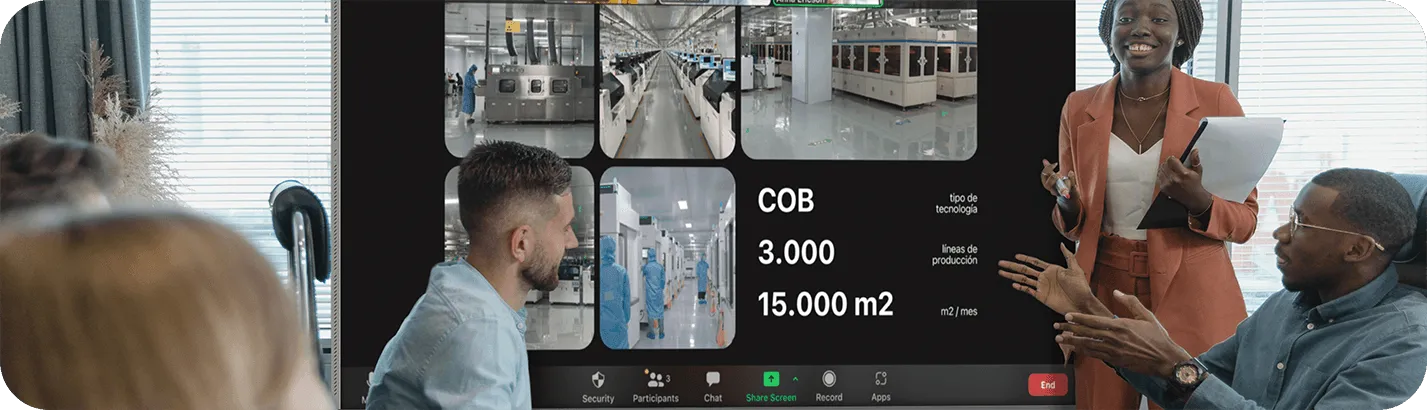
Integrating technology into education
Advantages of interactive displays
Versatility: They allow content to be presented in multiple formats.
Interactivity: They encourage active student participation.
Adaptability: They adapt to different teaching and learning methods.
Sensory stimulation: They combine visual, auditory and tactile elements.
Interactive displays are not merely viewing devices; they are dynamic learning hubs that can transform any classroom into a space for exploration and discovery. With the right software, these devices can meet the specific needs of each type of intelligence.
Technologies for linguistic intelligence
Practical applications
1. Digital storytelling platforms:
They combine text, images and audio to create multimedia stories. → Synetech Class
They encourage creativity and personal expression.
2. Debate tools:
They simulate online discussion environments. → Zoom, Google Classrooms
They promote argumentation and rhetoric.
They improve written and oral communication skills in a digital environment.
When integrated into an interactive display, these tools create an environment rich in linguistic stimuli that enhances language development in all its facets.
Enhancing logical-mathematical intelligence
Tools and strategies
1. Use of simulations:
Enables the construction and manipulation of geometric shapes. → Phet Simulations
Facilitates understanding of spatial relationships and theorems.
Encourages experimentation and the discovery of patterns.
Integrating these tools into an interactive display transforms the classroom into a mathematics laboratory where concepts come to life and students can explore, experiment and discover.
Developing spatial intelligence
Applications and activities
1. Interactive maps:
They facilitate the exploration of geography and topography. → Synetech Class, Canva
They develop orientation and navigation skills.
2. Puzzle games:
They challenge spatial perception and problem-solving.
They develop hand-eye coordination.
They encourage strategic thinking and planning.
When implemented through an interactive display, these tools transform the classroom into a three-dimensional exploration space, allowing students to visualise and manipulate spatial concepts in a tangible way.
Nurturing musical intelligence
Tools and activities
1. Virtual instrument simulators:
They allow students to practise various instruments without physical equipment. → Synetech Class
They offer interactive tutorials for learning techniques.
They facilitate exploration of different instrument families. → Nearpod
Implementing these tools through an interactive display transforms the music classroom into a production studio and sound laboratory where students can explore, create and analyse music in previously unimaginable ways.
Fostering interpersonal intelligence
Strategies and tools
1. Real-time collaboration platforms:
They enable joint work on documents and projects. → Synetech OS
They facilitate communication and the exchange of ideas. → Synetech Class
They encourage shared responsibility and group decision-making.
2. Educational multiplayer role-playing games:
They create virtual environments for practising social skills.
They encourage cooperation and teamwork.
They allow students to experience different roles and perspectives.
Implementing these tools through an interactive display transforms the classroom into a space for dynamic social interaction where students can develop and practise essential interpersonal skills in a safe, controlled environment.
Nurturing intrapersonal intelligence
Applications and methods
1. Mindfulness and meditation tools:
They guide mindfulness and relaxation exercises. → YouTube
They visualise breathing patterns and mental states.
They encourage awareness of the present moment.
2. Personality analysis applications:
They offer interactive questionnaires for exploring personal traits.
They provide insights into strengths and areas for improvement.
They help students understand patterns of behaviour and motivation.
Integrating these tools through an interactive display creates a personal space for reflection and growth where students can explore and develop their inner world in a structured, meaningful way.
Stimulating naturalist intelligence
Tools and activities
1. Species identification applications:
They use artificial intelligence to recognise plants and animals. → Synetech AI
They provide detailed information on characteristics and habitats.
They encourage the observation and classification of nature.
Implementing these tools through an interactive display transforms the classroom into a virtual nature laboratory where students can explore, observe and analyse the natural world in previously inaccessible ways.
Conclusion
The integration of interactive technologies into education, particularly the use of interactive displays, is transforming how we approach the development of multiple intelligences. These tools not only make it easier to adapt teaching to different learning styles, but also create opportunities for students to explore and develop their abilities in previously unimaginable ways.
As we move forward, it is crucial that teachers continue to explore and adopt these innovative technologies. The challenge and opportunity lie in using these tools not as ends in themselves, but as means of unlocking each student's unique potential. The future of education is taking shape as a space where technology and teaching converge to create truly transformative learning experiences.
Shall we talk?
Contact us for more information about SYNETECH's audiovisual solutions. Our professionals will contact you as soon as possible.