Interactive Displays
vs digital whiteboards
Interactive Display VS Digital Whiteboard
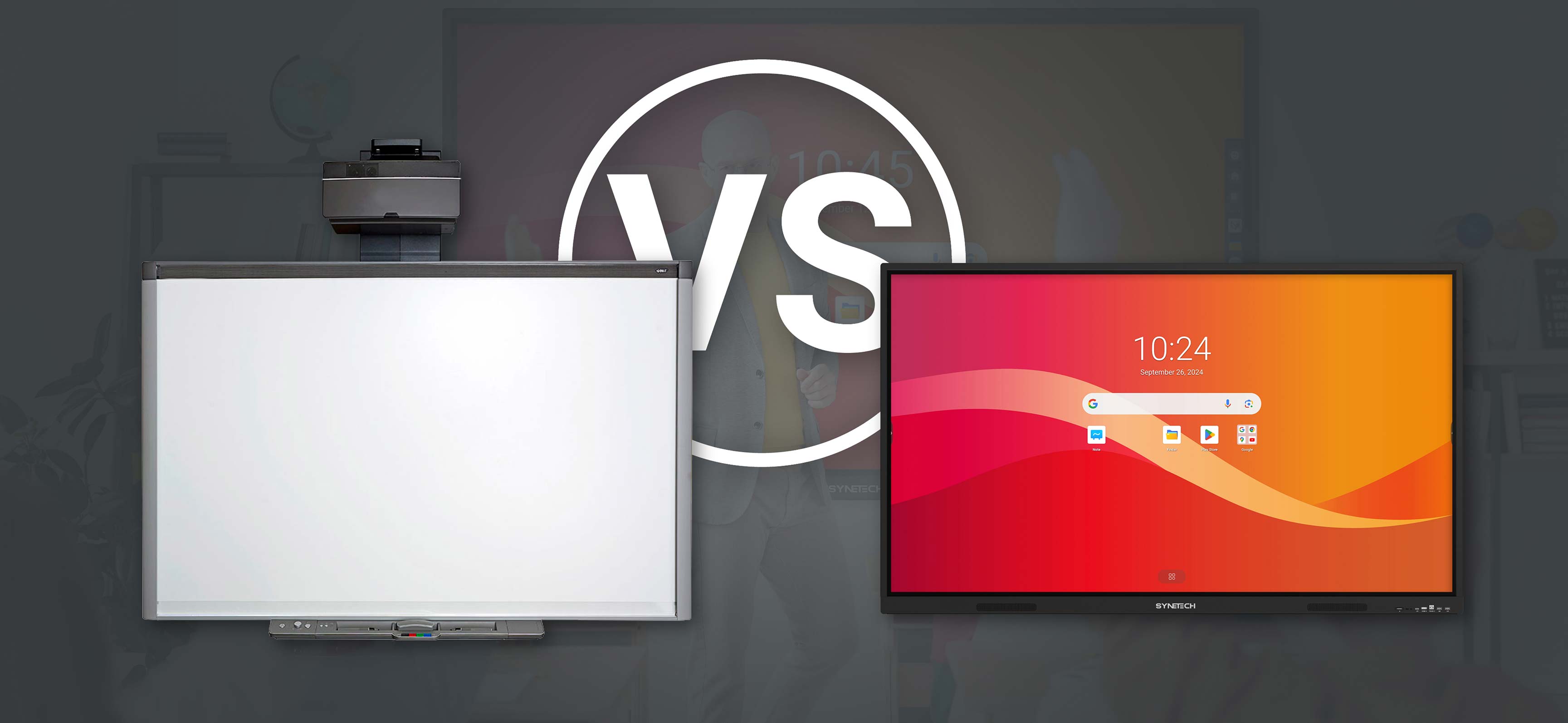
One example is the interactive display and the digital whiteboard; these two options are among the leading technologies for modernising educational spaces, each with its own distinctive features.
Fundamental technological differences
Examining the technological differences between these educational devices reveals significant contrasts in how they work.
Display and projection technology
A traditional digital whiteboard uses a projection system that requires a special board fitted with cameras and sensors. By contrast, the interactive display represents a significant evolution, operating as a standalone device that does not need an external projector.
A revealing figure shows that in 2020, 93% of schools chose purpose-built interactive displays instead of digital whiteboards. This trend is mainly due to superior image quality, with modern interactive displays offering more than 8.3 million pixels.
Interactivity and control systems
Interaction technology has evolved significantly. While digital whiteboards require frequent calibration to interpret the position of a stylus or finger correctly, modern interactive displays track these movements without calibration.
Installation and maintenance requirements
In terms of installation, digital whiteboards are more complex, requiring a projector mount and extensive cabling. Interactive displays offer a more compact solution that integrates every element into a single device.
Maintenance is another important differentiating factor. Digital whiteboards need regular lamp replacements; these lamps also contain mercury and require special handling. Interactive displays, by contrast, need minimal maintenance and offer greater durability.
Impact on user experience
User experience makes the crucial difference in the adoption of educational technology. Our analysis reveals how these devices affect daily classroom life.
Visual quality and ergonomics
Our interactive displays offer superior 4K resolution, vibrant colours and a wide viewing angle. Visual clarity is maintained even in brightly lit environments, where traditional digital whiteboards often have limitations.
Versatility and adaptability
The versatility of interactive displays is reflected in their ability to adapt to different educational settings. One study found a 31% increase in student performance when interactive and visual elements were introduced.
Modern interactive displays integrate more seamlessly with:
Comparison table
Conclusion
The versatility of interactive displays allows them to adapt to both educational and corporate settings, significantly improving collaboration and active learning. Their benefits extend beyond the traditional classroom, facilitating hybrid learning and connections between in-person and remote students.
Our experience allows us to say that interactive displays represent the future of educational technology, offering a more comprehensive and sustainable solution than traditional digital whiteboards. The choice between the two technologies will depend on the specific needs of each educational institution, but the advantages of interactive displays are undeniable for those seeking a durable and efficient educational solution.
Shall we talk?
Contact us for more information about SYNETECH's audiovisual solutions. Our professionals will contact you as soon as possible.