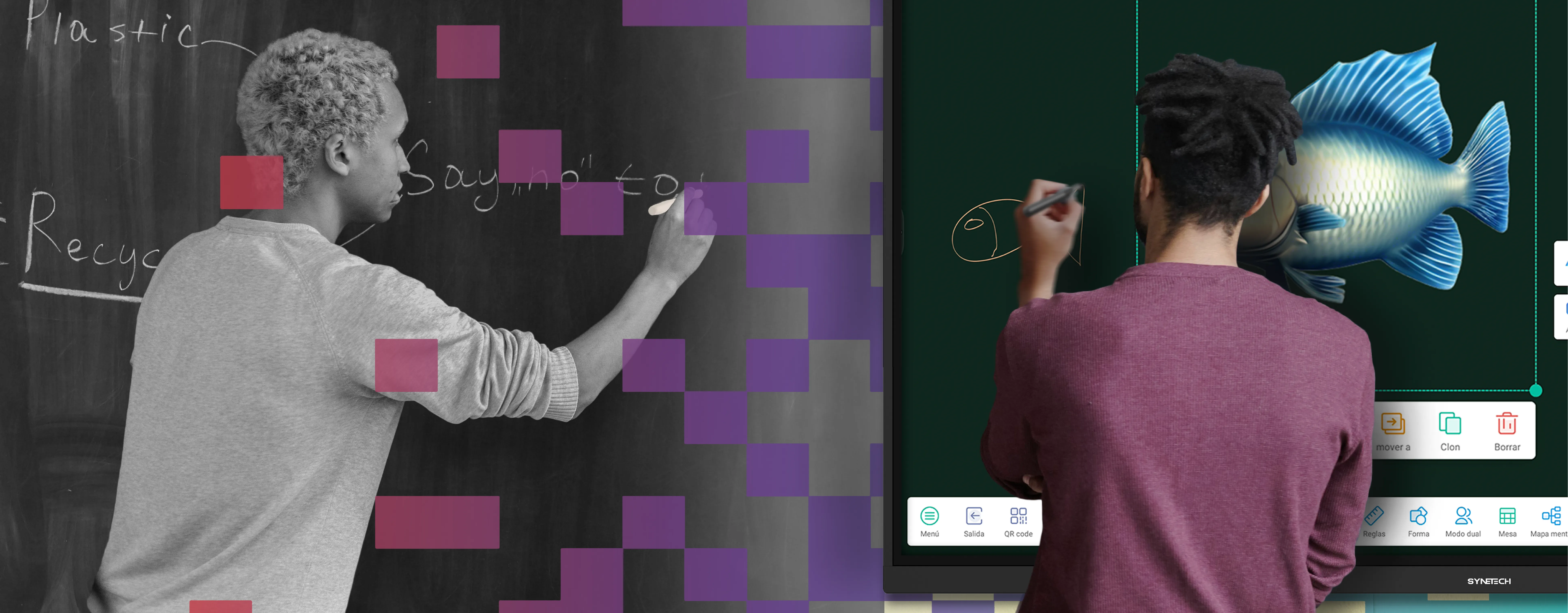
From chalk
to interactive displays
March - 2025
The evolution of technology in the classroom
Have you ever wondered how classroom technology has evolved over the decades? From the earliest blackboards and chalk to modern interactive displays, the journey has been remarkable. This transformation has not only changed the way teachers deliver their lessons, but has also redefined students' learning experience.
The era of the traditional blackboard
Advantages
Limitations
Versatility: the blackboard provided a blank canvas for any type of content.
Affordability: its low cost made it accessible to educational institutions at every level.
Durability: with proper maintenance, it could last for decades.
Simplicity: no technical knowledge was required to use it.
Its impact on classroom dynamics
The blackboard encouraged a teacher-centred style of teaching in which the teacher was the main source of knowledge. Students, meanwhile, took a more passive role, mainly taking notes and watching the explanations.


The arrival of projectors
In the 1980s, projectors began to gain ground in educational institutions, marking the beginning of a new era in the presentation of visual content in the classroom.
Advantages
Limitations
Expansion of visual content
Better visibility for the whole class
Need to darken the classroom
Maintenance costs due to frequent lamp replacement
Impact on teaching methods
Projectors enabled teachers to enrich their lessons with multimedia content, opening up new possibilities for explaining complex concepts and holding students' attention.
Digital whiteboards
In the late 1990s and early 2000s, digital whiteboards entered the educational landscape, combining the advantages of the traditional blackboard with digital technology.
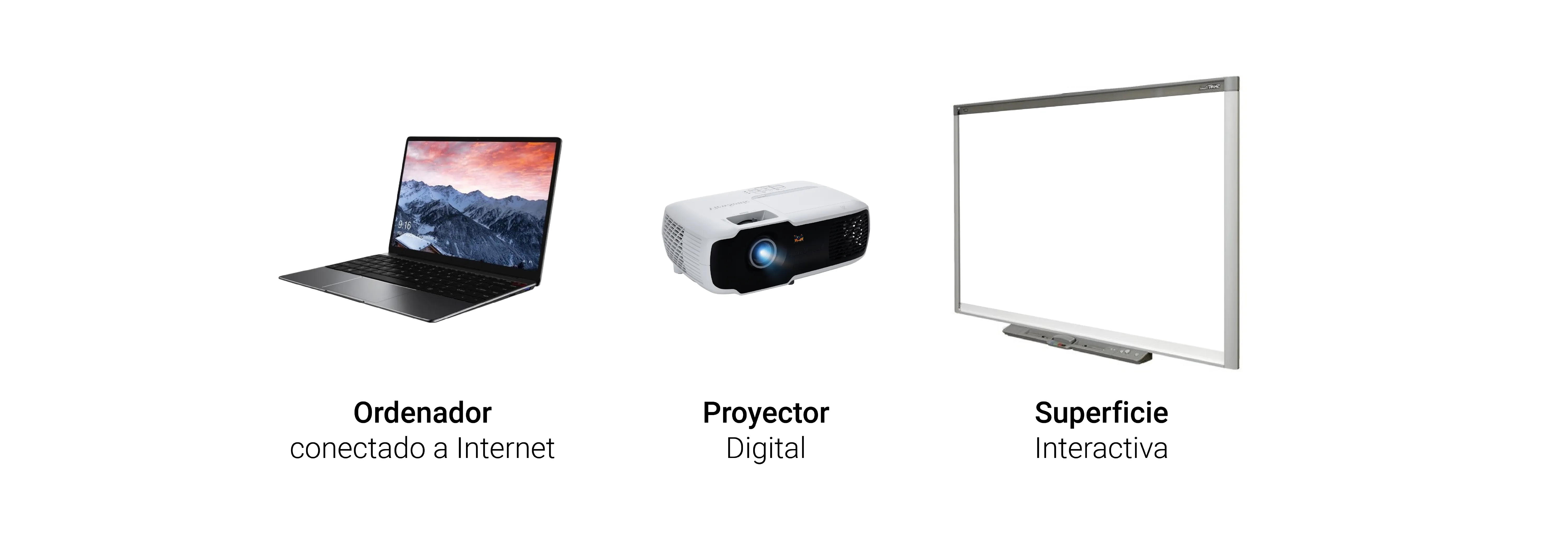
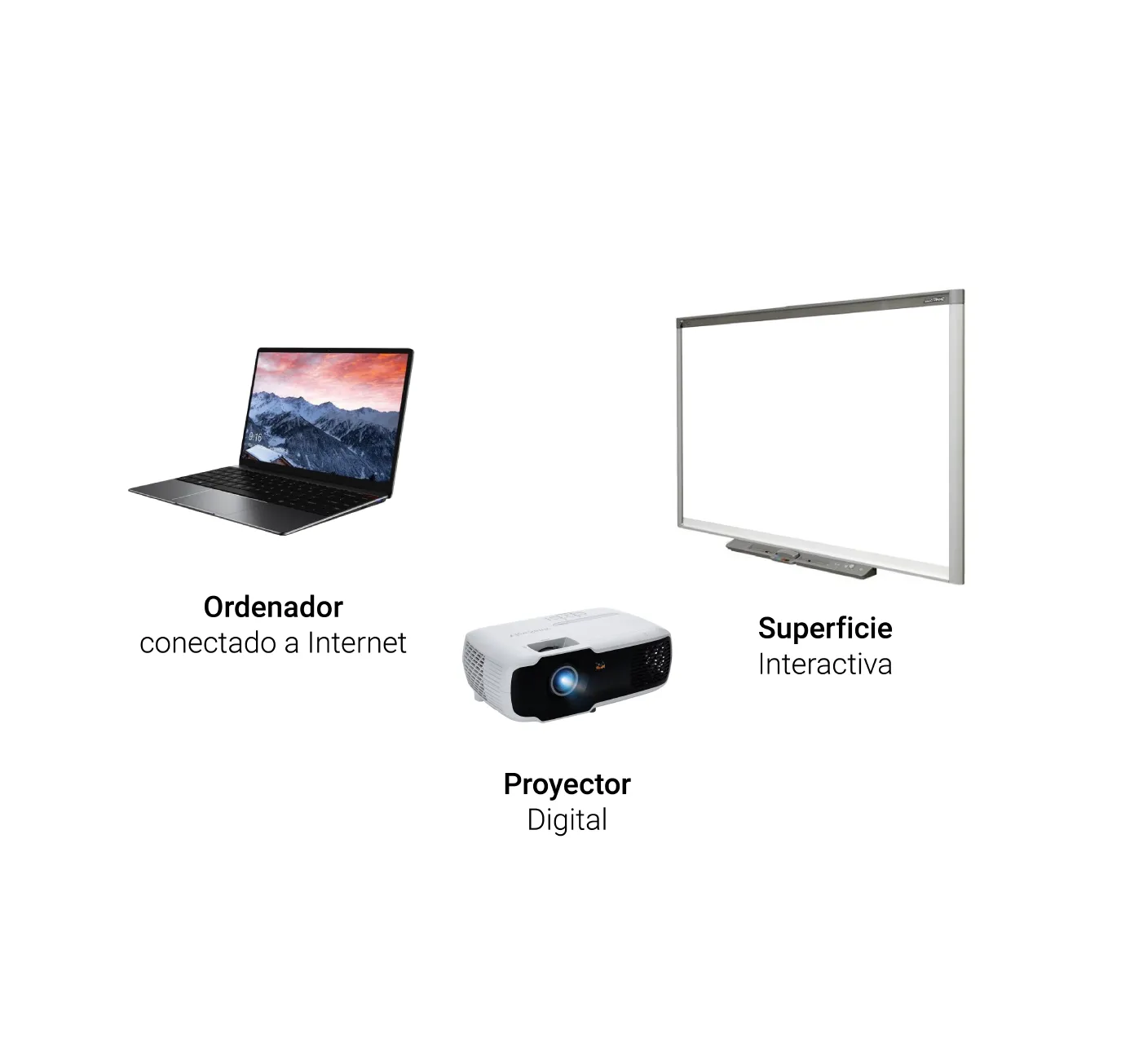
Components of a digital whiteboard
Innovative features
Digital whiteboards introduced features that transformed the classroom experience:
- Touch or electronic pen interaction
- Ability to save and retrieve lessons
- Integration of multimedia resources
- Ability to manipulate digital objects
Teacher adaptation
Introducing digital whiteboards required teachers to undergo a process of adaptation:
- Training in how to use the software
- Development of new teaching strategies
- Creation of interactive digital content
- Management of basic technical issues
The interactive display revolution
Today, interactive displays represent the pinnacle of educational technology in the classroom. These all-in-one devices combine the functions of a digital whiteboard with the power of a large-format touchscreen computer.
Advanced features
- High resolution and image quality
- Multi-touch for simultaneous collaboration
- Advanced wireless connectivity
- Integrated operating systems (Android, Windows)
Educational advantages
Interactive displays offer numerous advantages for the teaching and learning process:
- Greater student engagement
- Support for collaborative learning
- Instant access to online resources
- Adaptability to different learning styles
Impact on modern teaching
The introduction of interactive displays has had a profound impact on teaching methods and on the way students interact with educational content.
Find out more in Are interactive displays just a trend?
Find out more in Are interactive displays just a trend?
Active, participatory learning
Interactive displays foster a more dynamic learning environment:
- Students can manipulate content directly
- Collaborative problem-solving becomes easier
- Class participation increases
- Discussion and debate are encouraged
Personalised learning
Technology allows content to be tailored to individual needs:
- Adjustable learning pace
- Access to additional resources in real time
- Immediate assessment and feedback
- Individual progress tracking
Developing digital skills
Using interactive displays contributes to the development of essential technology skills:
- Familiarity with touch interfaces
- Use of educational software
- Searching for and evaluating online information
- Creation of digital content
Conclusion: a new educational paradigm
The transition from chalk to interactive displays represents far more than a simple change of tools. It symbolises a profound transformation in how we understand education and the role of technology in the teaching and learning process.
With their ability to foster collaboration, personalise learning and provide access to a world of digital resources, interactive displays are redefining what is possible in the classroom. However, it is crucial to remember that technology is a means, not an end in itself. The true value of these innovations lies in how they are used to improve the educational experience and prepare students for an increasingly digital, connected world.
MEET THE TEAM

Joshua
Writing

Julia
Editing

Álvaro
Layout
Share


Keep up to date with all
the latest education news.
the latest education news.

Artificial intelligence
in the workplace

Interactive displays
vs digital whiteboards

How digital displays
improve your team's performance

The metaverse
in education
find out more